Week 10: Multiple-Access Protocols, ARP
#Multiple-Access Protocols
#Multiple-Access Protocols 1
Why does CSMA not completely eliminate collisions?
- MAC addresses are not unique.
- CRC fails too often.
- Switches forward packets that collide with each other.
- Hosts that are far from each other have inconsistent views due to propagation delay.
#Multiple-Access Protocols 2
What is the purpose of exponential backoff?
- Reducing collisions under congestion.
- Accounting for the effects of propagation delay.
- Reducing CRC errors.
- Increasing the bandwidth of the link.
#Multiple-Access Protocols 3
Which of these is NOT a downside of token-passing?
- Delays can be high.
- Delays can be unbounded.
- There is a single point of failure.
- Token ring management adds overhead.
#Multiple-Access Protocols 4
After detecting a collision, what does an Ethernet NIC do?
- Continue transmitting the frame
- Send a jam signal and abort transmission
- Recalculate the CRC
- Change its MAC address
Answer with a number, like 1.
#Multiple-Access Protocols 5
Which of the following combinations results in the highest efficiency for Ethernet?
- High propagation delay, high transmission delay
- High propagation delay, low transmission delay
- Low propagation delay, high transmission delay
- Low propagation delay, low transmission delay
Answer with a number, like 1.
#Multiple-Access Protocols 6
An Ethernet NIC using exponential backoff has experienced 3 collisions. Which of the following is NOT a possible amount of slots it can wait before retransmission?
- 0
- 3
- 7
- 8
Answer with a number, like 1.
#Multiple-Access Protocols 7
What type of Wi-Fi scanning requires the host to send a request initially?
- Active scanning
- Passive scanning
- Collision scanning
- Backoff scanning
Answer with a number, like 1.
#Multiple-Access Protocols 8
Why does Wi-Fi use CSMA/CA instead of CSMA/CD?
- Wireless devices can easily detect collisions.
- Wireless devices cannot reliably detect collisions while transmitting.
- CSMA/CA is faster than CSMA/CD.
- CSMA/CD requires coordination between different hosts.
Answer with a number, like 1.
#Multiple-Access Protocols 9
Host A is a Wi-Fi device. It sends a RTS (request-to-send) and receives a corresponding a CTS (clear-to-send) reply granting host A permission to send data. Host A then sends its data, but doesn’t receive an ACK. What COULD NOT have been a cause for this?
- The data frame host A transmitted was corrupted or unable to reach the AP.
- A hidden Wi-Fi host that could hear neither the RTS nor the CTS transmission began transmitting at the same time, causing interference with the data frame.
- The ACK signal was sent by the AP, but it was lost or corrupted.
- A different Wi-Fi device, host B, simultaneously received a CTS signal from the same AP granting host B permission to send data. Host B decided to transmit a frame at the same time, causing a collision.
Answer with a number, like 1.
#ARP Simulation
#ARP Simulation 1
Consider the following network, where hosts A, B, and C are behind a switch. Initially, all ARP caches are empty. We are using a simplified version of MAC addresses where they are 2 bytes long instead of 6 bytes.
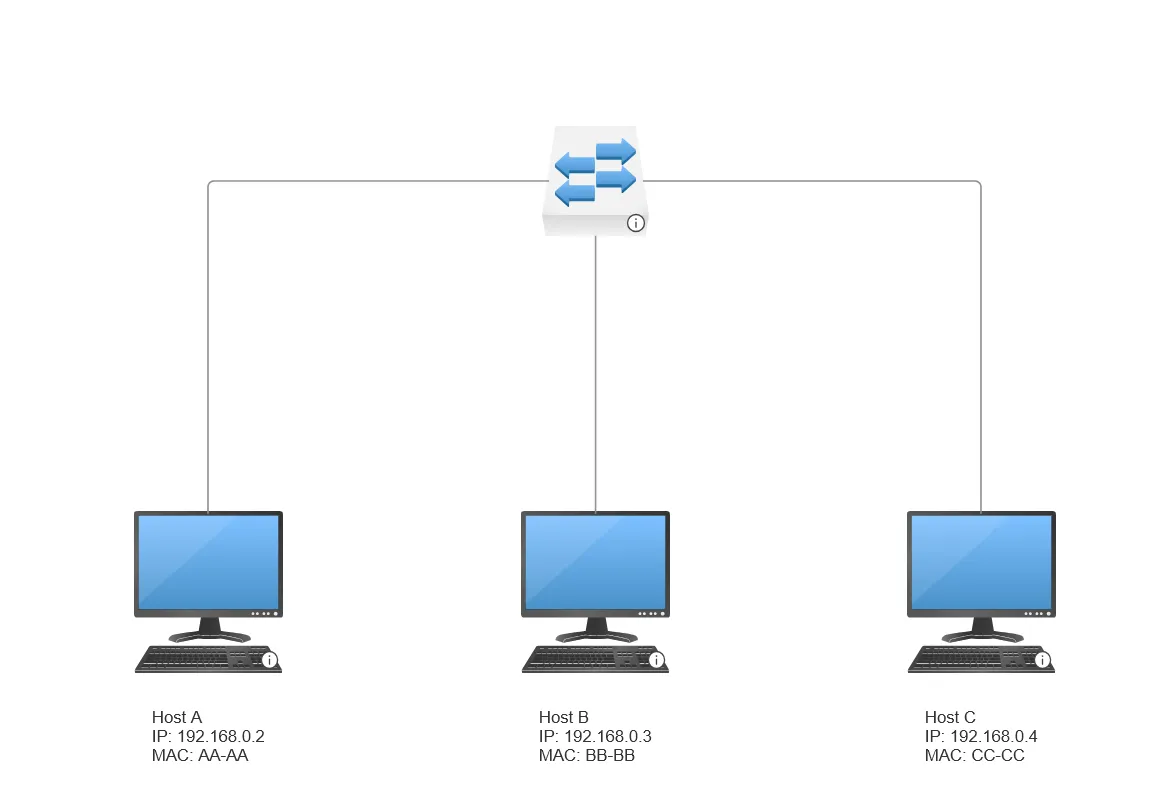
Why can’t host A immediately send a packet to host B? Answer in 10 words or less.
#ARP Simulation 2
Host A sends an ARP request. What are the values of the following 4 fields?
- Sender IP address
- Sender MAC address
- Target IP address
- Target MAC address
Answer in a comma-separated list of addresses, like 1.1.1.1,AA-AA,2.2.2.2,BB-BB.
#ARP Simulation 3
Host B sends an ARP reply to A’s request. What are the values of the following 4 fields?
- Sender IP address
- Sender MAC address
- Target IP address
- Target MAC address
Answer in a comma-separated list of addresses, like 1.1.1.1,AA-AA,2.2.2.2,BB-BB.
#ARP Simulation 4
Are host A’s request and host B’s response unicast or broadcast?
- A’s request is broadcast. B’s response is broadcast.
- A’s request is broadcast. B’s response is unicast.
- A’s request is unicast. B’s response is broadcast.
- A’s request is unicast. B’s response is unicast.
Answer with a number, like 1.
#ARP Simulation 5
Which of the following devices now have an entry in their ARP cache?
- Host A
- Host B
- Host C
- The switch
Answer with a comma-separated list of numbers, like 1,2,3.